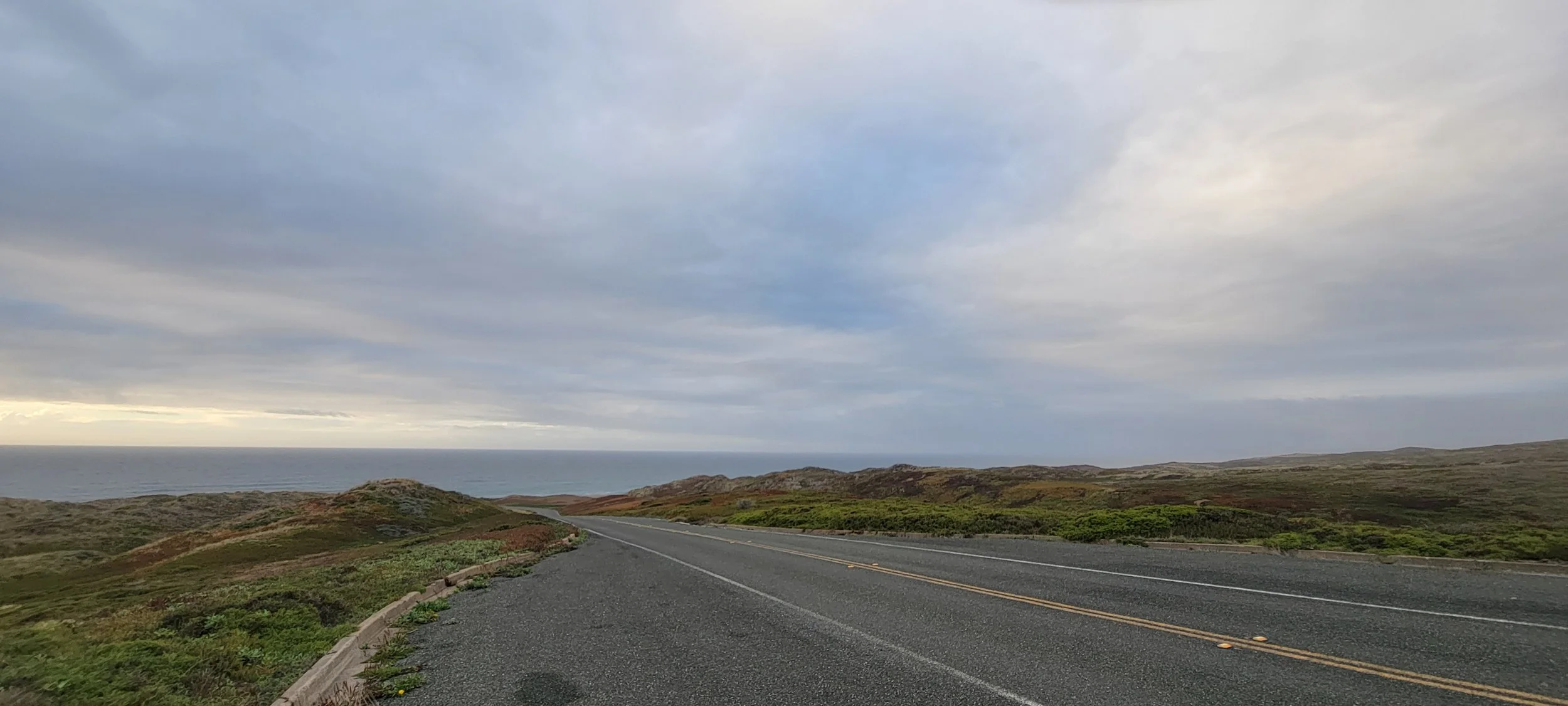
Road to South Beach, Pt. Reyes, CA.
There is a difference between living a life and managing a life.
For a long time, I think many of us are taught to manage ourselves. Manage our emotions. Manage our image. Manage our responsibilities. Manage our fear.
And especially for men, there can be an additional lesson underneath all of that:
Be strong.
Don't be afraid.
Don't cry.
Don't need too much.
Don't be vulnerable.
Don't let people see you fall apart.
Be the provider. Be dependable. Work hard. Keep going.
There is nothing wrong with strength, responsibility, or a good work ethic. In fact, those qualities can be beautiful.
But there is a problem when we confuse being strong with never allowing ourselves to feel weak.
Because fear doesn't disappear simply because we have decided we're not supposed to feel it.
Neither does grief.
Neither does shame.
Neither does loneliness.
Neither does vulnerability.
Neither does uncertainty.
They simply find somewhere else to go.
Fear has a purpose. It just isn't supposed to run your life.
I don't actually like feeling afraid.
I don't want to be afraid.
But I've come to understand that fear has a purpose. It is information. Sometimes it is telling me there really is something I need to pay attention to. Sometimes it is warning me about danger.
And sometimes?
Sometimes it is simply telling me that I'm doing something unfamiliar, vulnerable, uncertain, or emotionally uncomfortable.
Those are not the same thing.
The ability to distinguish between them has changed the way I think about fear.
I don't have to get rid of it.
I can feel it.
I can listen to it.
I can ask what it is trying to tell me.
And then I can decide whether it gets to make the decision.
Because fear can come along for the ride without driving the car.
I learned this in a very personal way.
There have been times in my life when I was afraid and did the thing anyway.
I have asked for what I wanted and been rejected.
It hurt.
Of course it hurt.
But I survived the feeling.
And what surprised me was that I didn't regret having asked.
I would rather have experienced the vulnerability of asking than spent my life wondering what might have happened if I had been brave enough to try.
That taught me something important:
Being afraid doesn't mean you shouldn't do something.
Sometimes being afraid simply means that what you're doing matters to you.
And sometimes the most important thing you can learn is that the feeling you were afraid of experiencing is survivable.
You can be rejected and survive.
You can be disappointed and survive.
You can be embarrassed and survive.
You can be afraid and survive.
You can love someone deeply and eventually lose them and survive.
That last one is perhaps the hardest truth of all.
If we love people, eventually we will lose people.
Unless we die first, we will experience the loss of everyone we love.
That is not a flaw in the system.
That is the price of having a life that contains love.
So what kind of life do we want?
One organized around making sure nothing ever hurts?
Or one in which we accept that some things will hurt because the alternative is missing much of what makes life worth living?
I think about men when I think about this.
I think about how many boys are taught that fear is weakness.
That crying is weakness.
That needing someone is weakness.
That vulnerability is weakness.
That a man is supposed to be tough enough not to be affected.
But what if that lesson doesn't create strength?
What if it creates men who become extraordinarily good at avoiding the feelings they don't know how to tolerate?
What if a man learns that happiness is acceptable but sadness isn't?
That confidence is acceptable but fear isn't?
That desire is acceptable but vulnerability isn't?
That anger is acceptable but grief isn't?
Then he may become very practiced at experiencing the feelings he has permission to have and escaping the ones he doesn't.
And sometimes the escape looks like addiction.
Sometimes it looks like anger.
Sometimes it looks like emotional withdrawal.
Sometimes it looks like work.
Sometimes it looks like control.
Sometimes it looks like never getting close enough to another person that they could really hurt him.
From the outside, some of these behaviors can look like strength.
But avoiding an emotion isn't the same thing as becoming strong enough to feel it.
My husband is part of this story.
He never, ever wanted to be an example of what not to do.
In his own mind, he was doing things the right way.
And in some ways, he was.
He had an extraordinary work ethic. He worked hard. He showed up. He believed in doing his job and taking care of his responsibilities.
Those were real strengths.
But he was also human.
And being human means that none of us are machines.
You cannot simply program yourself with all the correct behaviors and expect the uncomfortable parts of your inner life to disappear.
My husband had addictions.
He smoked constantly. He could chain-smoke, sometimes leaving one cigarette burning in the kitchen while going outside and lighting another.
Whatever was happening inside him, the behavior told its own story: something about changing his internal state had become very important.
I can't know exactly what he was feeling every time he reached for a cigarette or a drink.
But I know this much:
The human being underneath the behavior was more complicated than the behavior itself.
He wasn't a machine.
He wasn't simply “good” or “bad.”
He was a human being who had strengths, weaknesses, coping mechanisms, wounds, habits, and feelings that he didn't always know how to inhabit.
And that matters to me now because I don't think the answer is to shame people for the ways they have learned to cope.
The answer is to become curious about what those behaviors are doing for us.
What feeling are we trying not to feel?
What experience are we trying to escape?
What happens inside us when we simply stay?
That is where metacognition becomes freedom.
There is a profound difference between:
“I'm afraid, so I need to get away.”
and:
“I'm afraid. Let me see what this feeling actually is.”
Maybe your chest gets tight.
Maybe your stomach drops.
Maybe your thoughts start racing.
Maybe you want to call someone, drink something, smoke something, withdraw, attack, explain, fix, or run.
And instead of immediately obeying the impulse, you become curious.
What am I feeling?
What am I afraid will happen?
Is there actual danger here?
Or is this simply discomfort?
That is the beginning of inhabiting your inner life.
Not controlling every feeling.
Not getting rid of fear.
Not becoming endlessly introspective.
Just becoming capable of staying present long enough to discover:
“Oh. This is a feeling.”
And feelings move.
They rise.
They peak.
They change.
They pass.
We don't have to turn every feeling into an emergency.
You are not inhabiting your life if fear is making all the decisions.
You can build a very orderly life around avoidance.
You can avoid rejection.
Avoid vulnerability.
Avoid uncertainty.
Avoid grief.
Avoid needing people.
Avoid asking for what you want.
Avoid taking chances.
Avoid feeling afraid.
And from the outside, that life might even look perfectly functional.
But there is a question worth asking:
How much of your actual life are you experiencing if your primary goal is to never feel uncomfortable?
Because life is not only the absence of fear.
Life is also wanting something.
Trying.
Failing.
Loving.
Losing.
Beginning again.
Being surprised.
Being vulnerable.
Feeling joy.
Feeling grief.
Being terrified and taking the next step anyway.
That is inhabiting your life.
I don't want to become fearless.
I don't think that's possible, and I'm not sure I would even want it.
I want something better.
I want to be able to say:
“Yes, I'm afraid. And I'm still going.”
Because fear can come along for the ride.
It just doesn't get to drive.
