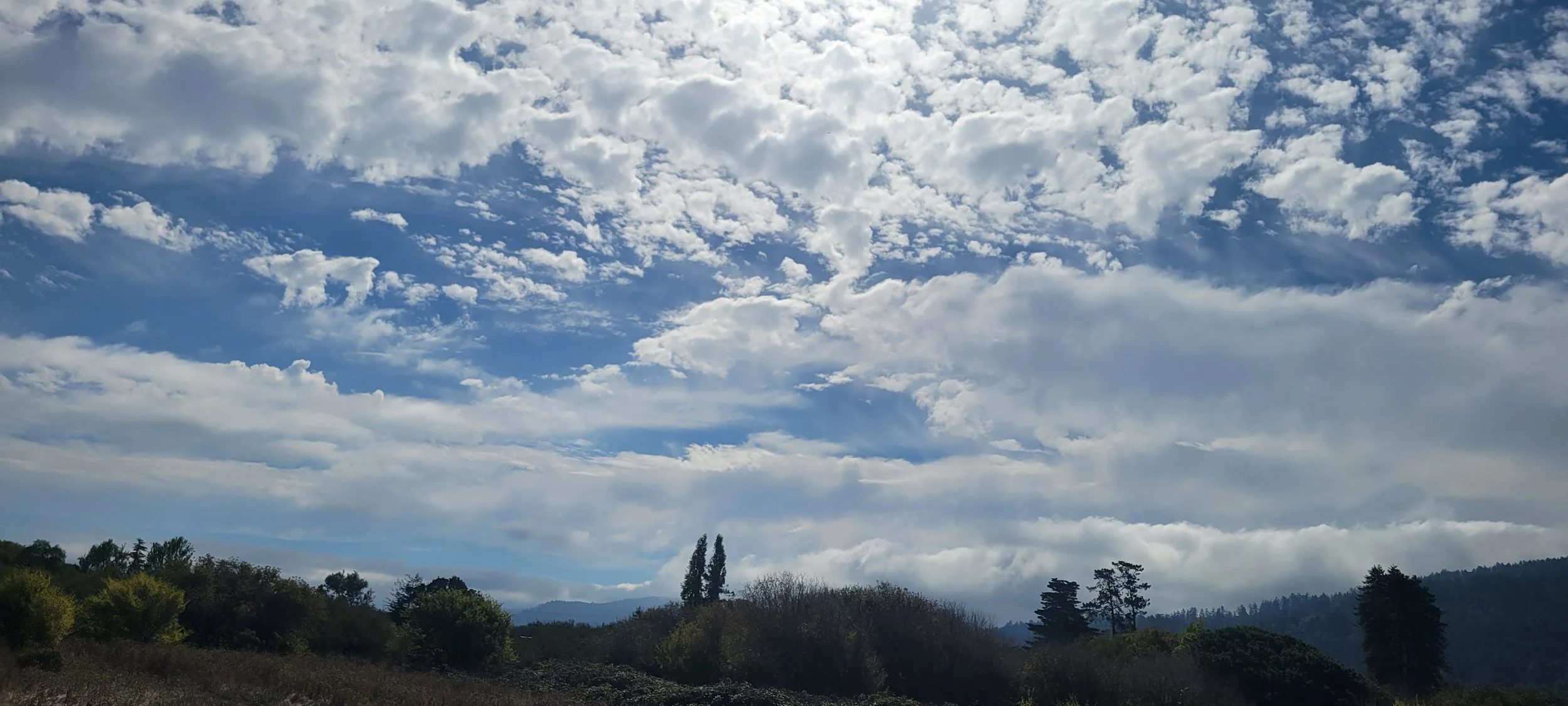
West Marin Mountains and Open Sky
I grew up believing that questioning was simply something Americans did.
We questioned things.
We disagreed.
We argued with our parents.
We argued about politics.
We complained about presidents.
We made jokes about politicians.
We read different newspapers.
We voted.
We changed our minds.
We protested.
We asked uncomfortable questions.
And somehow, I never thought of that as a particularly extraordinary privilege.
I thought it was simply part of being American.
The freedom to question.
Lately, I've found myself thinking about that freedom differently.
Because what happens when questioning becomes a form of disloyalty?
What happens when disagreeing with a leader is portrayed as being against the country?
What happens when “real Americans support us” becomes the message—and the people who question the leader are characterized as enemies, traitors, crazy, or unpatriotic?
Something important begins to shift.
The question is no longer:
Is this true?
It becomes:
Are you with us?
And those are very different questions.
I've been thinking about this through the lens of something I've been learning about myself: metacognition.
It's the ability to step back from our own thoughts and examine them.
To notice not only what we think, but how we came to think it.
And that little bit of distance can be enormously important.
Because I can ask:
Did I conclude this myself?
Or was I taught it?
What evidence supports it?
What evidence contradicts it?
Am I afraid to question it because I might be wrong—or because I'll lose belonging if I do?
Am I listening to this person because what they're saying makes sense, or because everyone around me says I'm supposed to believe them?
That isn't cynicism.
It's reality-testing.
And I think healthy people need it.
Healthy families need it.
Healthy communities need it.
And healthy democracies absolutely need it.
This doesn't mean we all have to agree.
Quite the opposite.
That's where the idea of pluralism becomes so important.
Pluralism is the idea that people with profoundly different beliefs can exist together without requiring everyone to become the same.
I can believe one thing.
You can believe another.
We can discuss it.
We can disagree.
We can even think the other person is completely wrong.
And still recognize:
You are allowed to have your own mind.
That doesn't mean every idea is equally true.
It doesn't mean we abandon evidence.
It doesn't mean we stop standing up against things we believe are harmful.
It means disagreement itself isn't treated as proof that the other person is an enemy.
I've experienced the opposite of this in family life.
I've seen what happens when a family has an unquestioned authority and everyone else is expected to play their assigned role.
The system can become so accustomed to its own rules that the person who questions them isn't treated as someone offering useful information.
They're treated as the problem.
And that's what interests me.
Because the same human dynamics can appear in very different places.
Families.
Religious communities.
Political movements.
Workplaces.
Friend groups.
Any system can become closed when questioning becomes forbidden.
And once questioning becomes forbidden, reality becomes very difficult to correct.
That's why I don't think loving your country and agreeing with your president are the same thing.
I think loving your country means caring enough about it to pay attention.
To question.
To notice.
To participate.
To disagree when necessary.
To listen to people who see things differently.
To remain curious about what you might be missing.
And to remember that a president is a person who holds an office.
The country is bigger than the person occupying it.
America belongs to the people who agree with the president.
And it belongs to the people who don't.
It belongs to people who vote differently.
People who worship differently.
People who don't worship at all.
People who grew up here.
People who came here.
People who love the country fiercely.
People who are deeply disappointed in it.
That's pluralism.
And perhaps that is one of the freedoms worth protecting most carefully:
the freedom to question the people who hold power.
Not because every question is correct.
Not because every criticism is fair.
But because a society that cannot tolerate questions eventually loses one of its most important ways of discovering when something has gone wrong.
So I keep coming back to a very simple sentence:
I don't know yet. Let me look.
I want to keep that sentence.
I want to keep asking questions.
I want to remain willing to discover that I'm wrong.
I want to be able to listen to someone I disagree with without automatically surrendering my own mind—or turning theirs into an enemy.
And I want to live in a country where we can still do the same.
Because perhaps freedom isn't simply the freedom to say what we believe.
Perhaps it is also:
the freedom to ask whether what we believe is true.
And perhaps that little space between what we were taught and what we actually think is where freedom begins.
