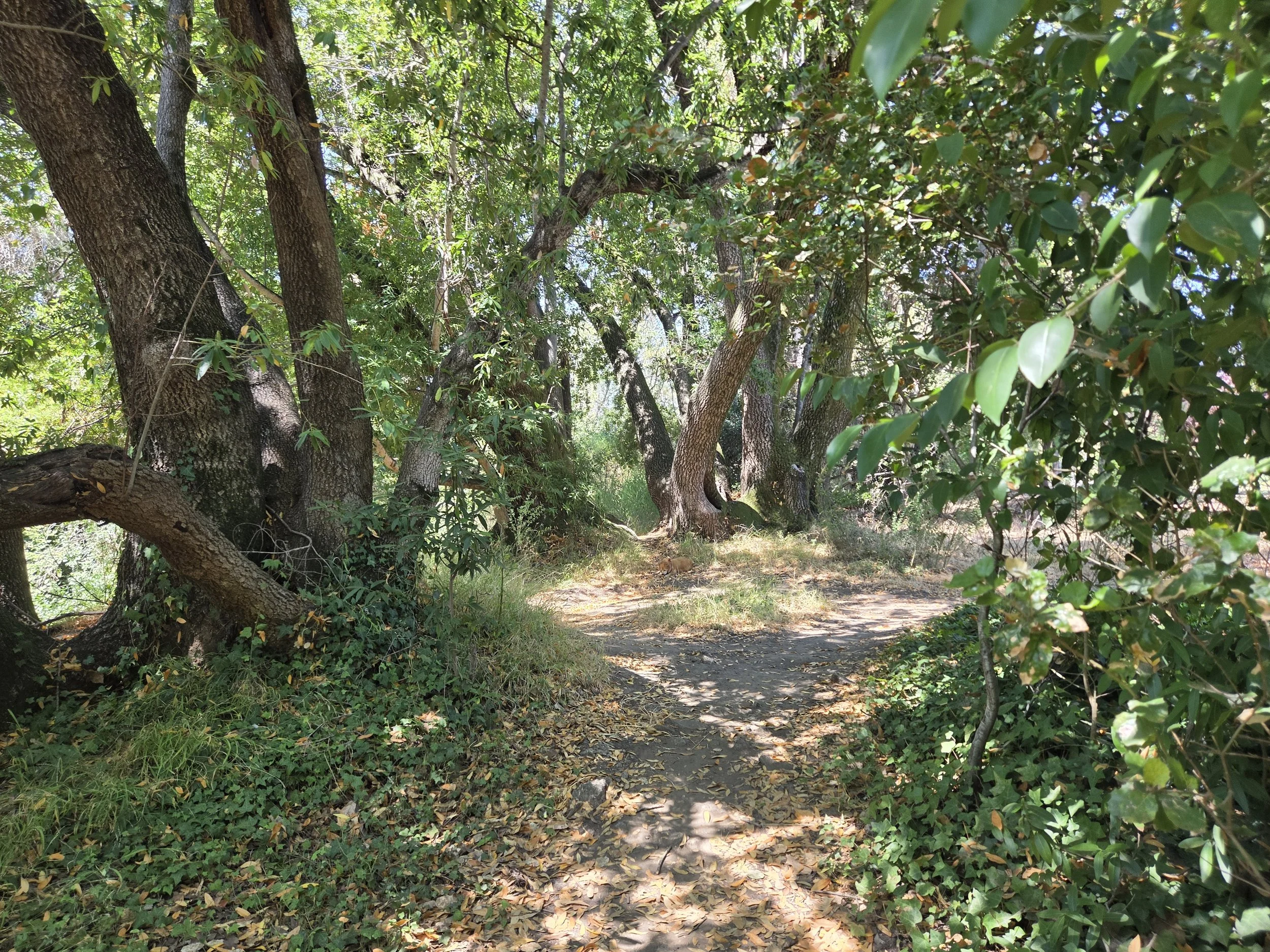
Path to Father Tree Novato, CA.
There is a space that exists between what we are taught to believe and what we actually believe.
For some people, that space may be quite large.
For others, it may barely exist at all.
I've been thinking about this lately because I suddenly realized something about myself that I had never really considered: I grew up with a surprising amount of room to discover what I actually thought.
Nobody handed me a detailed instruction manual for being Diana.
My grandmother tried, briefly, to introduce me to religion. I wasn't buying it. She seemed to recognize that pretty quickly, and that was more or less the end of it.
My parents didn't make me go to church.
They weren't constantly telling me what I was supposed to believe about God, other people, politics, or the world.
My mother was a fairly introverted woman. My father was often absent, working and taking care of the practical business of keeping the family going. Our world was relatively small.
And yet, inside that small world, I had something enormous:
room to think.
I could ask my mother questions.
I could wonder about things.
I could explore.
I could form my own opinions.
And I didn't have the experience of someone standing over me saying, This is what people like us believe.
I think I assumed everyone grew up this way.
I assumed that people were generally taught something, thought about it, examined it, and then decided whether they agreed.
It turns out that isn't necessarily how it works.
Some people are taught not only what to believe, but what a good person believes.
They are taught what to wear.
How to behave.
Who to trust.
Who not to trust.
What questions are acceptable.
What questions are dangerous.
What happens when they disagree.
And sometimes those lessons begin so early and are reinforced so consistently that eventually what they were taught becomes indistinguishable from what they think.
There is no longer much space between the two.
And that little space matters.
Because that space is where we can ask:
Why do I believe this?
Where did this idea come from?
Who taught me this?
Do I actually agree with it?
What would happen if I questioned it?
Could I be wrong?
That is metacognition to me.
It's the ability to step slightly outside your own thoughts and look at them.
Not to reject everything you've learned.
Not to assume everything you've learned is wrong.
Simply to notice:
I was taught this.
And then:
Do I actually think this?
That distinction can be the beginning of freedom.
I think I've always had a fairly strong relationship with that little space.
Even as a kid, if something didn't make sense to me, I had a tendency to think, Well, that doesn't make sense.
I didn't necessarily need to convince everyone else.
I just didn't feel obligated to abandon my own perception because someone else was more certain than I was.
That became particularly obvious later in my life, when I found myself inside family systems where there were very strong ideas about how everyone was supposed to behave.
There were roles.
Expectations.
Unspoken rules.
And I remember thinking:
You believe that. I'm going to believe what I believe.
It wasn't necessarily rebellion.
It was something simpler.
I didn't understand why someone else's certainty required my agreement.
Looking back, I think that was one of the reasons I felt so uncomfortable in closed systems.
A closed system doesn't simply have beliefs.
It has rules about believing.
And once questioning itself becomes a problem, that little space begins to disappear.
I've come to think that one of the greatest gifts we can give another person is not our answers.
It's room for them to develop their own.
I tell people things all the time:
This is what I would do.
This is how I see it.
This is what has worked for me.
But I also say:
Don't just listen to me. Come to your own conclusions.
Because I don't want someone else's inner world to become a copy of mine.
I want them to have their own.
And perhaps that's one of the quiet forms of freedom we don't talk about enough:
the freedom to have your own mind.
To listen.
To consider.
To question.
To change your mind.
To say I don't know.
And, perhaps most importantly:
“I don't know yet. Let me look.”
There is a lot of freedom in those words.
Because they leave the door open.
And when the door is open, curiosity can walk through.
